Home › Guides › SMS scams: parking, refund and delivery texts to avoid
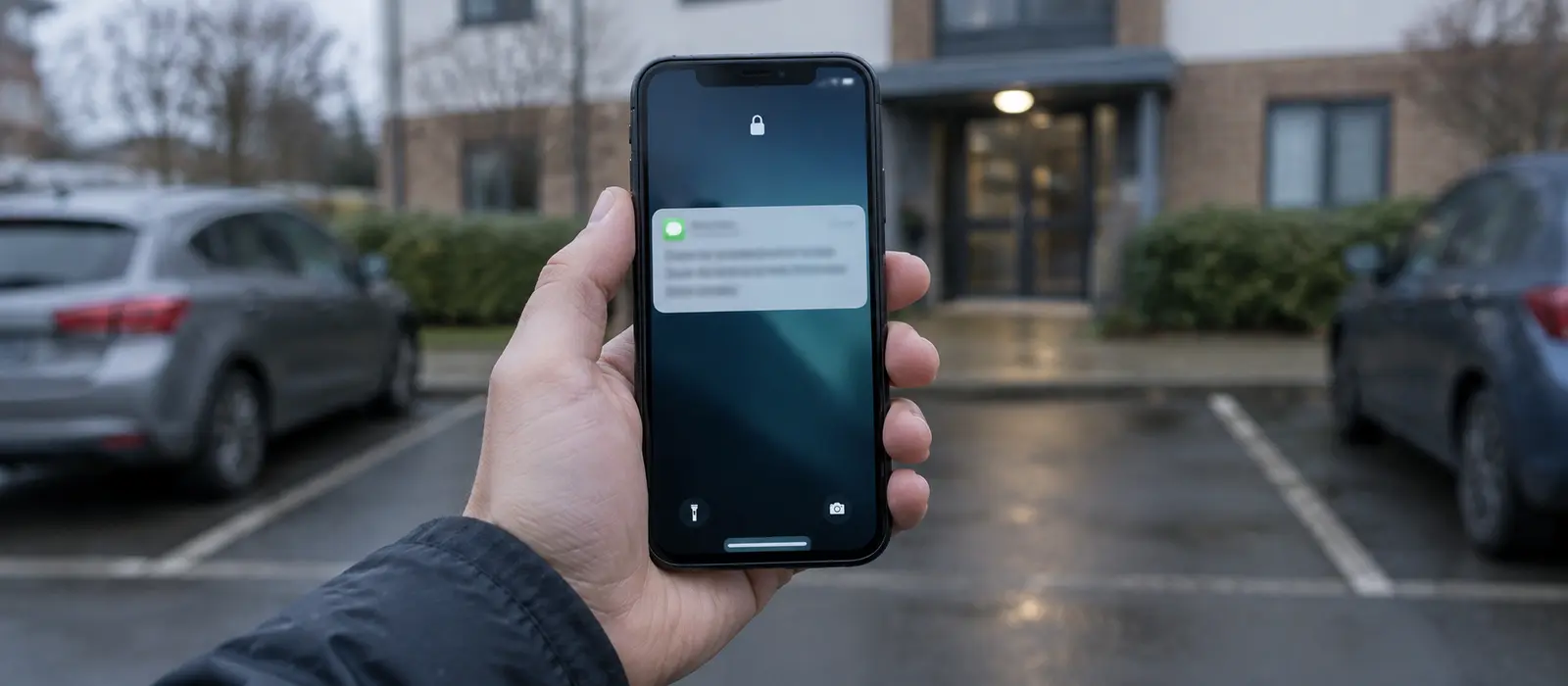
Scam text messages have become more convincing than ever. Criminals impersonate parking enforcement, car finance companies, and delivery services to steal money or personal details. Learning to spot these scams in the seconds before you click a link can save your money and identity.
Fake parking fine texts
Parking scam texts typically claim you’ve received a parking violation notice and owe a fine that you must pay immediately, with a made-up amount designed to sound plausible. The message includes a link to “view the violation” or “pay the fine.” The sender may use a name resembling a real parking operator or local council, like “ParkingEng” or “Local Council Enforcement.”
These texts target drivers who genuinely have parked in town centres or at train stations, banking on the panic that comes with thinking you’ve been caught. A legitimate parking enforcement notice arrives by post or email, not text. If you do receive a parking ticket, it will have an official reference number, details of the alleged breach, and instructions for appealing—never a link to click immediately.
If you’re unsure about a parking fine, check your council’s website or contact them directly (not via the number or website in the text). Pay no attention to artificial urgency in the message. A genuine penalty charge notice gives you 28 days to pay in full or appeal, with a reduced rate usually available if you pay within 14 days—far longer than the pressure tactics scam texts rely on.
PCP and car finance refund scams
These messages claim you’re eligible for a refund under the Financial Conduct Authority’s car finance compensation scheme, offering a made-up sum of compensation and asking you to click a link to “claim your refund” or provides a phone number to call. The sender might pose as the FCA itself or a firm offering to claim compensation on your behalf.
The FCA is addressing widespread failures by lenders to properly disclose commission arrangements on car finance agreements taken out between 6 April 2007 and 1 November 2024. However, this scheme has faced legal challenge, and compensation calculations and payments are on hold pending the outcome; anyone contacting you claiming payments are ready now should be treated with suspicion. The FCA does not contact customers via text to offer compensation, and never asks for your bank PIN or online banking password. If you’re eligible, you’ll usually need to contact your lender directly to make a complaint, using contact details you’ve found independently rather than ones in a text message.
Scammers use the FCA’s real scheme to make the offer sound legitimate. They either steal your details after you click and enter information on their fake site, or charge fees upfront for a claim process that’s actually free.
If you believe you’re eligible for compensation, contact your car finance lender directly and ask about the scheme. Visit the FCA’s official website (fca.org.uk) using a search engine, never by clicking a link in a text or email.
Missed delivery and parcel scams
These messages mimic delivery companies like DPD, Hermes, DHL, or Amazon. They state that a parcel couldn’t be delivered and ask you to click a link to reschedule or collect it. The message may include a partial tracking number to appear authentic.
Legitimate delivery notifications are sent via email or your delivery app, not text messages in most cases. If you are expecting a parcel, monitor your account through the official delivery company’s app or website, don’t respond to unexpected texts. Real delivery companies never ask you to pay to reschedule or collect a parcel through a link in a text.
When clicked, these links lead to convincing fake delivery company websites where you enter your address, phone number, or payment details. Your information then feeds directly to criminals.
If you’re unsure about a delivery status, open your email and look for the official delivery notification, or log into the company’s website directly (not via a link). Never click links in unsolicited texts about parcels.
How to recognise scam SMS
Several red flags indicate a scam text: urgency (“Act now,” “Pay immediately,” “24-hour deadline”), a link you must click to proceed, a request for personal details or payment, an unsolicited offer you didn’t apply for, poor spelling or grammar, an unfamiliar sender name despite claiming to be official, and a generic greeting like “Dear Customer” rather than your actual name.
Scammers research you using information available online. If you’ve posted about parking in town or have posted about your car on social media, a parking scam text feels targeted and believable. The more convincing the scam, the more important it is to independently verify before clicking anything.
If you’ve already clicked
If you clicked a link and entered personal information—name, address, phone, email, payment details, or banking information—act immediately. First, don’t panic. Second, don’t send any money if asked. Third, change your passwords for email and banking, especially if you entered passwords on the fake site.
Contact your bank or card issuer and flag the transaction if any charges appear. Monitor your bank account carefully for the next 30 days. Check your credit file using free services like Experian or Clearscore to catch any fraudulent credit applications. If you’ve given your phone number, expect scam calls or texts for a while; block the numbers and report them.
Report the incident to Action Fraud, the UK’s national fraud reporting service. You can report online at actionfraud.police.uk or call 0300 123 2040. Include the scam text, the link, the sender’s number, and any details you remember. Law enforcement uses these reports to track scam patterns and take action against criminals.
Report scam texts to 7726
Immediately forward the scam text to 7726 (a five-digit number) by typing 7726 into your phone’s messaging app and sending the original text as a reply. This reports the scam to your mobile network provider, which works with other networks and authorities to block the sender and remove malicious links. As of July 2026, the 7726 service has successfully removed scams across over 93,000 URLs.
Many networks cover the cost of sending the report to 7726, though it may count as a text message if your plan has limited texts. It’s worth sending even if you’re charged; the report helps protect others.
How criminals get your details
Criminals obtain your phone number from leaked databases, public social media profiles, or by sending mass messages hoping to catch victims. The more information you share online—your car type, photos from holidays, mentions of shopping—the easier it is for scammers to target you with realistic messages. Keep social media privacy settings strict and avoid oversharing personal details online.
If you’re on the electoral register and your details are publicly listed, you’re easier to find. Some people request to be removed from the public register; check your local council’s website for the option.
Key points
- Parking scam texts claim unpaid fines; legitimate parking notices arrive by post
- PCP refund texts falsely offer compensation; the FCA doesn’t contact via text
- Missed delivery texts target people waiting for parcels; real notifications come via email or apps
- Red flags: urgency, links, requests for details, generic greetings, and poor grammar
- If you clicked, change passwords, monitor accounts, and report to Action Fraud
- Forward scam texts to 7726 immediately to report and block the sender
- Limit personal information shared online to reduce targeting by scammers
Related: Find IT support near you